MY PAINTINGS EMERGE VIA AN
INTERTWINING DANCE OF FORM, LIGHT,
COLOR AND EXPRESSIVE BRUSHSTROKES
- ALL IN SERVICE OF THE MOOD OF THE MOTIF
In the early 1970s, Monet’s Rouen Cathedrals mesmerized me by dissolving into abstraction as I stepped closer to the paintings. The emotive effect of Monet’s complex layers of broken color continue to influence my work.
THE FORCES OF NATURE
AND MYSTIQUE OF OTHER SPECIES
ARE THE IMPETUS BEHIND MY PAINTINGS
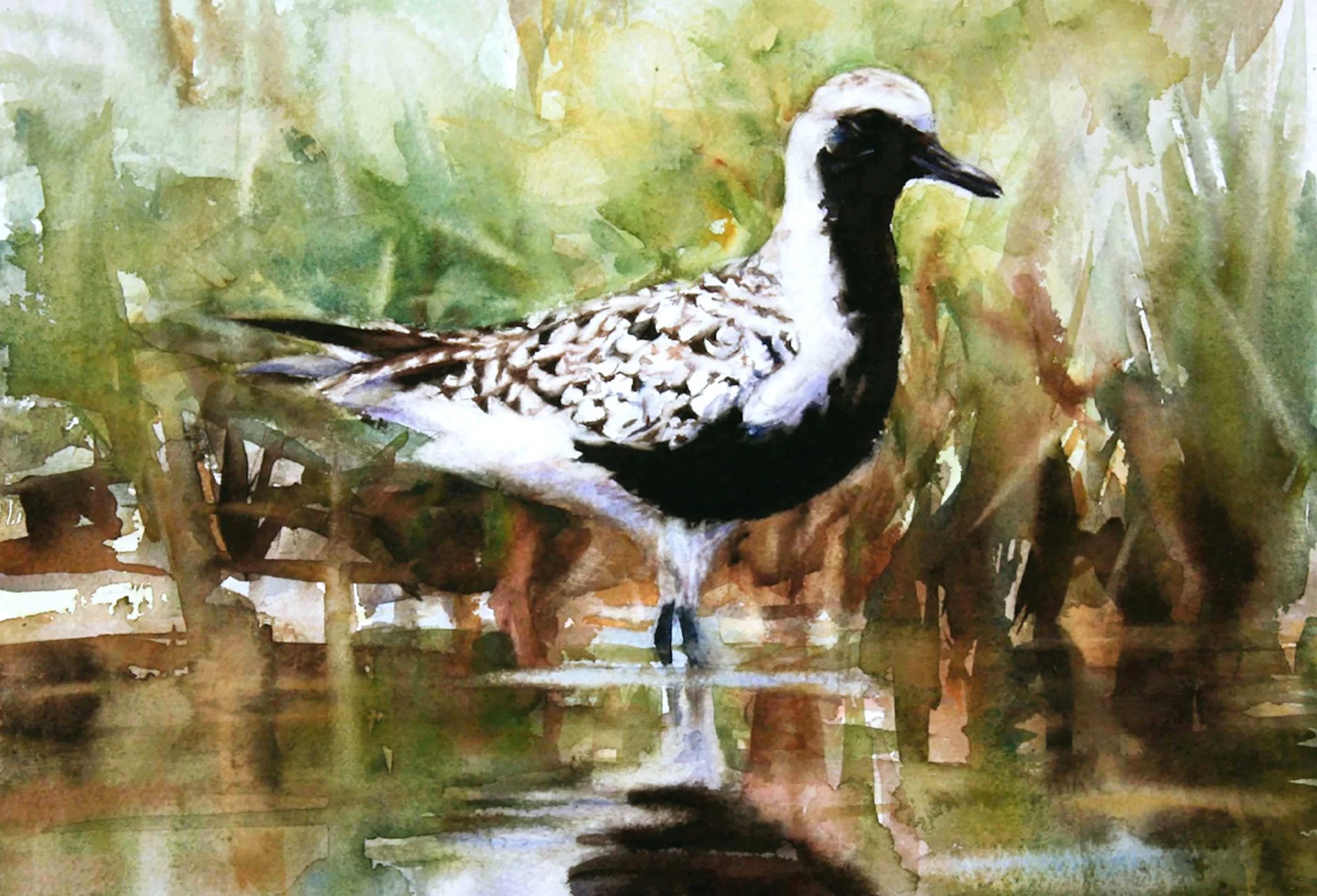
A childhood fascination with birds progressed into serious birding in the 1980s. Yet I craved a deeper connection to these elegant beings. Painting birds from life, immersing myself in their world, achieves this desire. Watching them play out their daily drama reveals unique perspectives within the landscape, my source of inspiration for paintings.
Merging passions - painting and birds, I completed a second BFA, 1985 - 1990. While studying painting and drawing of the figure with oil at the University of Utah I simultaneously taught myself to draw and paint birds from life.
I loved painting with oil, however, I no longer medically tolerate pure drying oils. This forced me into an exploratory transition from oil to egg tempera to watercolor. My form of expression evolved from layering dragged strokes in oil to painting with pigments ground in gum arabic and honey, utilizing an array of wash techniques. Watercolor washed, dashed and dragged across a gorgeous white watercolor sheet results in a brilliance capable of capturing the visual effect of the light of nature.
As tantalizing as the effect of transparent watercolor is, the truth is, watercolor presents many challenges compared to oil, requiring more stamina, planning and exploration to realize my vision.
MATERIALS
It is important that the work I do for birds and their environment — our environment — involves little negative impact. In attempting to bring awareness and requests to please notice and change what we are doing to the birds, how many species, as well as, individual birds we are loosing at an incredibly troubling rate, I do not want to add to the toxicity. 1
I am witness; my health is directly affected by toxins.
I spent years searching worldwide for watercolor papers created with the least amount of environmental impact. I continually work at selecting the safest palette of pigments.
ARCHIVAL
All of my paintings are created on archival, 100 % cotton papers, selected for their minimal environmental impact. I will note when the cotton is organic. The pigments I choose are lightfast. I only frame paintings with UV protective glass or UV protective acrylic.
PERMANENCE OF WATERCOLOR
There is a misconception of the permanence of watercolors. Ralph Mayer, author of The Artist’s Handbook of Materials and Techniques, states, “When permanent colors are used on pure rag watercolor paper and the picture is kept under the same normal conditions of preservation as are accorded other objects of art, the technique is as permanent as any other. It is not true that the colors are liable to be faded by daylight because they are exposed in such thin films; only the semipermanent or borderline pigments are likely to fade; they will be affected in the same way when used in oil or tempera, though such change may be somewhat less noticeable in those colors liable to be faded by daylight because they are exposed in such thin films; only the semipermanent or borderline pigments are likely to fade; they will be affected in the same way when used in oil or tempera, though such change may be somewhat less noticeable in those techniques on account of the larger volume of color employed.” 2
1 Weidensaul, Scott; A WORLD ON THE WING, The Global Odyssey of Migratory Birds, 2021, W. W. Norton & Company, Inc., Chapter 4: Big Data, Big Trouble
2 Mayer, Ralph; THE ARTIST’S HANDBOOK OF MATERIALS AND TECHNIQUES, 1991, page 328, 5th ed. / 1991
PAINTING ACROSS BANNER
NUMMY ISLAND, BLACK-BELLIED PLOVER, 2009, watercolor on Arches paper, private collection